Resident Evil Requiem – PC Tech Review

Performance Scaling – RT Off to Path Tracing

Ray tracing is as performance-intensive as ever
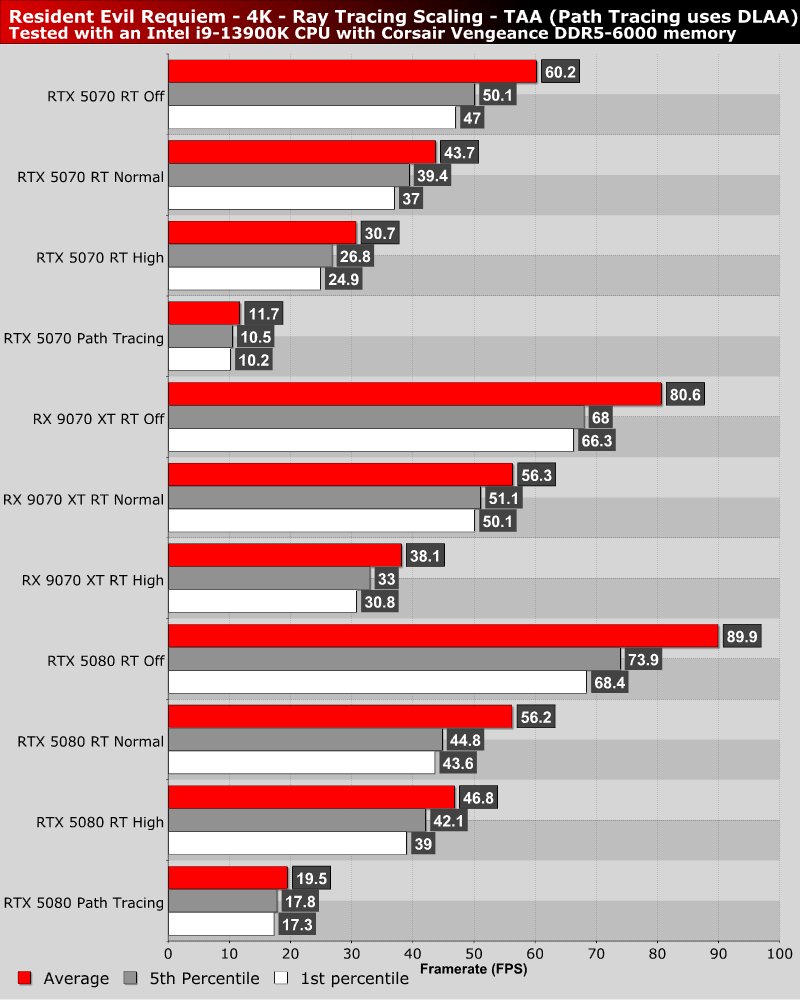
If you want Resident Evil Requiem to run faster on PC, the easiest thing to do is to disable ray tracing. Even setting ray tracing to “normal” has a huge performance impact.
As mentioned before, path tracing is not available to users of AMD and Intel GPUs. Because of this, we could not test our Sapphire RX 9070 XT Pulse with path tracing enabled. However, we will note that AMD’s RX 9070 XT delivered excellent ray tracing performance, with results that are fairly close to Nvidia’s RTX 5080.
Ray tracing is very demanding and memory-intensive. At 4K, using RTHigh resulted in a significant performance drop on our RTX 5070 because the GPU utilised its full 12GB frame buffer. The performance drop was not as large on Nvidia’s RTX 5080.
Path tracing is incredibly demanding, delivering less than half of the framerate of ray tracing in high mode. It is intended to be used alongside DLSS Upscaling and Frame Generation to run at higher framerates. We will test Path Tracing with DLSS in later pages in this article.