

Lian Li PC-O7S Review

Up Close: Exterior
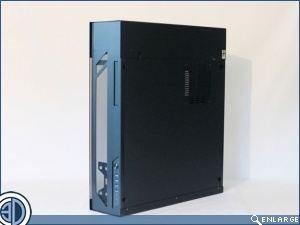
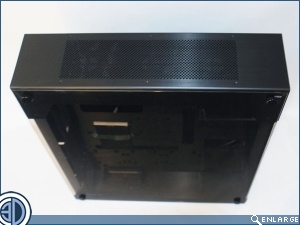
It’s really quite hard to communicate both the size and the grace of the Lian Li PC-O7S. It really is a sight to behold. It’s also an absolute sod to photograph, firstly because the large amount of glass necessitates the use of a polaroid filter, and secondly because at just under 10kg it needed both myself and Mrs Dubs to move it around the light booth, and don’t even get me started on fingerprints!!! But these are the first world problems of a hardware reviewer and not really your concern. What you really want to know is, what’s it like.

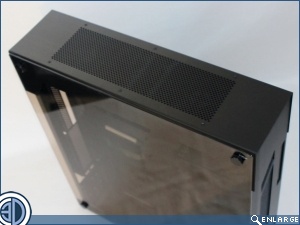
Having gazed in awe at the overall beauty of the case let’s take our usual trip around the exterior. Up on the roof there’s a long perforated section that gives air to up to three 120mm fans. This roof is actually 514mm long, which means the base is also 514mm long, so if you’re thinking of putting the case on the desk beside you, best you check your desk is deep enough first. Actually, scrap that, if you’ve got the £355 to buy this case, you’ve got the money to buy a bigger desk if you need it.
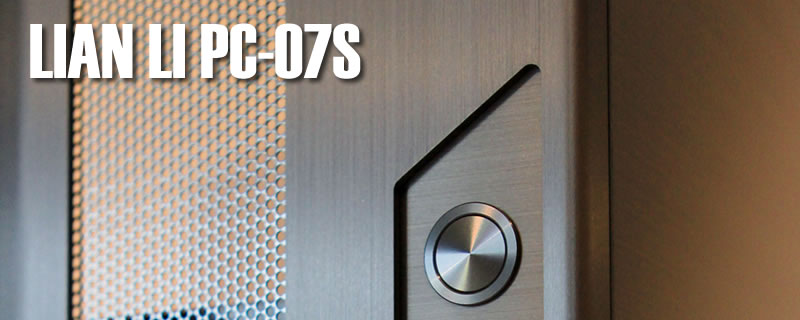
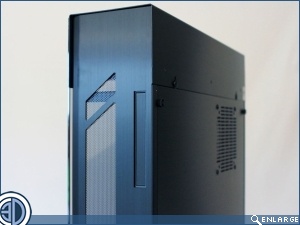
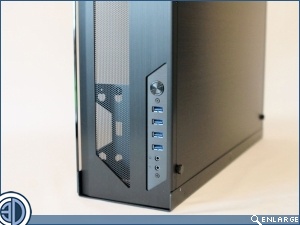
As with the rest of the exterior, the front of the case is finished in line brushed Aluminium. A fine mesh is then inset into geometric cut outs to allow air to pass in and out of the case interior. It should be noted that although this is quite a fine mesh, there’s no filtering here so it’s quite likely that the case will be something of a dust magnet. There’s also a bay cover for a slim optical drive discretely positioned in the front panel. Down towards the bottom we then find the front I/O which consists of no less that four USB 3.0s and a pair of HD audio sockets. The case is powered by means of a very classy vandal style button.
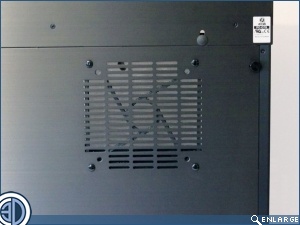
Where the left side of the case is elegant in the extreme, the right side is very industrial and utilitarian. If you’re wall mounting the case, this isn’t really an issue as this side will never be seen, however if it’s on the desk top you are going to see it, so perhaps Lian Li could have done a little more other than lob in a 140mm fan grill in the top right hand corner. Oh, that and the ugly sticker they’re decided to attach to it.
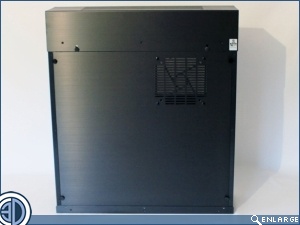
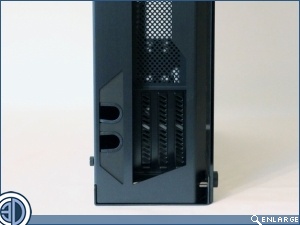
The rear of the case is largely open with no mesh or filters in evidence. Right down at the bottom though we find the rear I/O area with its four PCI slots. The other two holes ore for the power cable and other cables to exit in order to keep things as tidy as possible. Having looked at the side panel above, we should mention that it actually does have a mesh filter internally.