

Assassin’s Creed Odyssey PC Performance Review


CPU Performance – What was Ubisoft thinking?
Most PC gamers aim to play games at or around 60FPS, ensuring smooth character movements in-game as well as faster controller response times. Some PC gamers even consider 60FPS a must, making Assassin’s Creed: Odyssey an immediate “no buy” for some PC users.
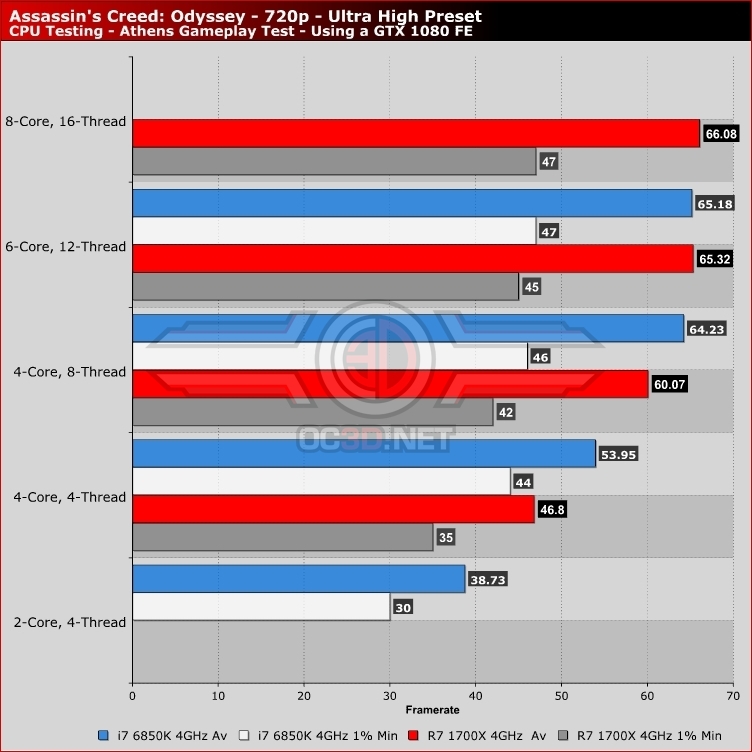
Assassin’s Creed: Origins presented these same performance issues, with 60FPS only being possible outside of major population centres, even on our high core count systems. Even at a resolution of 720p, we found that Assassin’s Creed Odyssey was unable to maintain 60 FPS at Ultra High settings on a GTX 1080 graphics card.
The benchmarking data below comes from an area within the City of Athens, which is one of the most demanding locations within the game. Every major settlement has areas where CPU utilisation will peak, thanks to the high levels of clutter and characters in each of these scenes.
720p High Settings
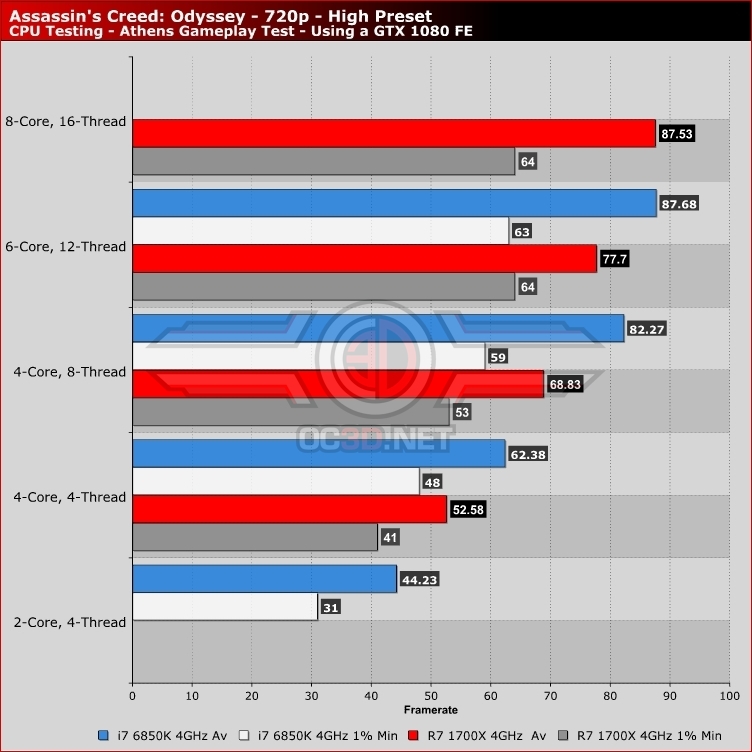
Like it’s predecessor, Assassin’s Creed: Odyssey loves high core count CPUs, making use of all additional cores and threads to offer increased performance levels. The only problem here is that even with a 4GHz 6 core/12 thread i7-6850K or a 4GHz 8 core/16 thread Ryzen 7 1700X, steady 60 FPS framerates are barely achievable at 720p, showcasing a clear CPU performance limitation.
Even with AMD’s help during development, Ubisoft was unable to address the sheer CPU demands of Assassin’s Creed’s AnvilNext 2.0 engine. This fact is a strange thing to consider, as the same engine is used in both For Honor and Ghost Recon: Wildlands, both of which offer impressive visuals on the AnvilNext 2.0 engine the same CPU-based limitations.
Things only get worse if we move to higher graphical presets.
720p Ultra High Settings
Maxing out Assassin’s Creed: Odyssey, the game only gets more demanding on processors, with none of our system achieving a steady 60 FPS at 720p. Similar framerates are achievable at 1080p, showcasing a clear CPU-based performance limitation. We believe that Assassin’s Creed Odyssey’s Environmental Detail settings are what causes this huge increase in CPU overhead.
To play Assassin’s Creed: Odyssey at 60FPS will require PC gamers to purchased Ultra-high-end CPUs and overclock them to achieve the highest levels of single-threaded performance that they can, making this game a great use-case of Intel’s i9-9900K. The problem with this is that no current-generation PC game should require this much CPU grunt for 60FPS gameplay, especially when the Jaguar cores on today’s consoles can achieve 30FPS framerates with relative ease.
Ubisoft needs to either rethink how they are utilising processors in their Assassin’s Creed series, or invest in transitioning the game’s engine over to a low-level API like DirectX 12, which can be used to decrease the game’s CPU overhead.
When we learned that AMD was partnering with Ubisoft to help create the game’s PC version, we hoped that this meant that Ubisoft was serious about addressing their CPU-based performance issues. Ubisoft clearly didn’t care enough to address this issue, making this one of the only games that benefit from having 8 or more threads but cannot achieve much higher than 60FPS on an overclocked Ryzen 7 1700X.