

Death Stranding 2: On the Beach PC Performance Review

AMD FSR 4.1

AMD’s FSR 4.1 upscaler is now available
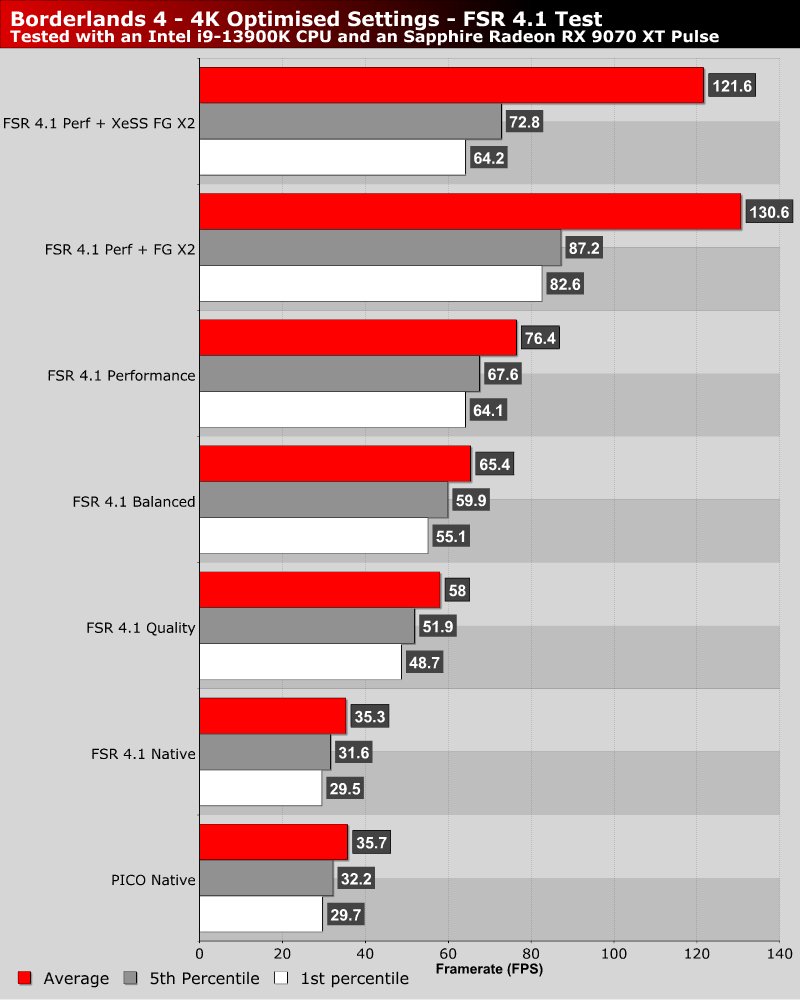
Like DLSS, FSR 4.1 delivers better upscaling results than Death Stranding 2’s PICO (Progressive Image Composter) upscaler. That said, PICO delivers better results than FSR 3. This means that RX 9000 series GPU owners should use FSR 4.1, but users of older AMD GPUs should use PICO.
Like DLSS, FSR 4.1 can dramatically improve framerates in Death Stranding 2, especially when playing the game with maxed-out settings. That said, we would recommend turning off ray tracing in this game due to its minimal visual impact. With that being the case, it is very easy to achieve 60+ FPS at 4K using AMD’s RX 9070 XT, even without Frame Generation.
Like many other games with FSR Frame Generation, Death Stranding has frame pacing issues when this tech is enabled. Some generated frames appear too fast, and the spacing between them is uneven. This results in strange frame pacing and low 1st- and 5th-percentile framerates in our charts. This is not ideal. We were able to enable XeSS Frame Generation on our Radeon RX 9070 XT, so we also tried it. This test also suffered from the same frame pacing issues.
Frame Pacing is a problem that AMD needs to address with future versions of FSR. It is a common problem in games and can be easily detected using frametime capture software with the “MsBetweenDisplayChange” metric. Using VSYNC will allow FSR Frame Generation to correctly pace frames, though doing so isn’t ideal. After all, most PC gamers prefer an unlocked framerate.